For a private residence, design development typically runs six to ten weeks from appointment to a complete drawing set. Execution runs anywhere from eight weeks for a flat interior to eighteen months or more for a house built from the ground up. Those are working ranges, not promises, and the single biggest variable is not construction speed. It is how long decisions take. A project where the client decides in two days per question finishes months earlier than one where each question waits a fortnight.
What are the stages, and how long does each take?
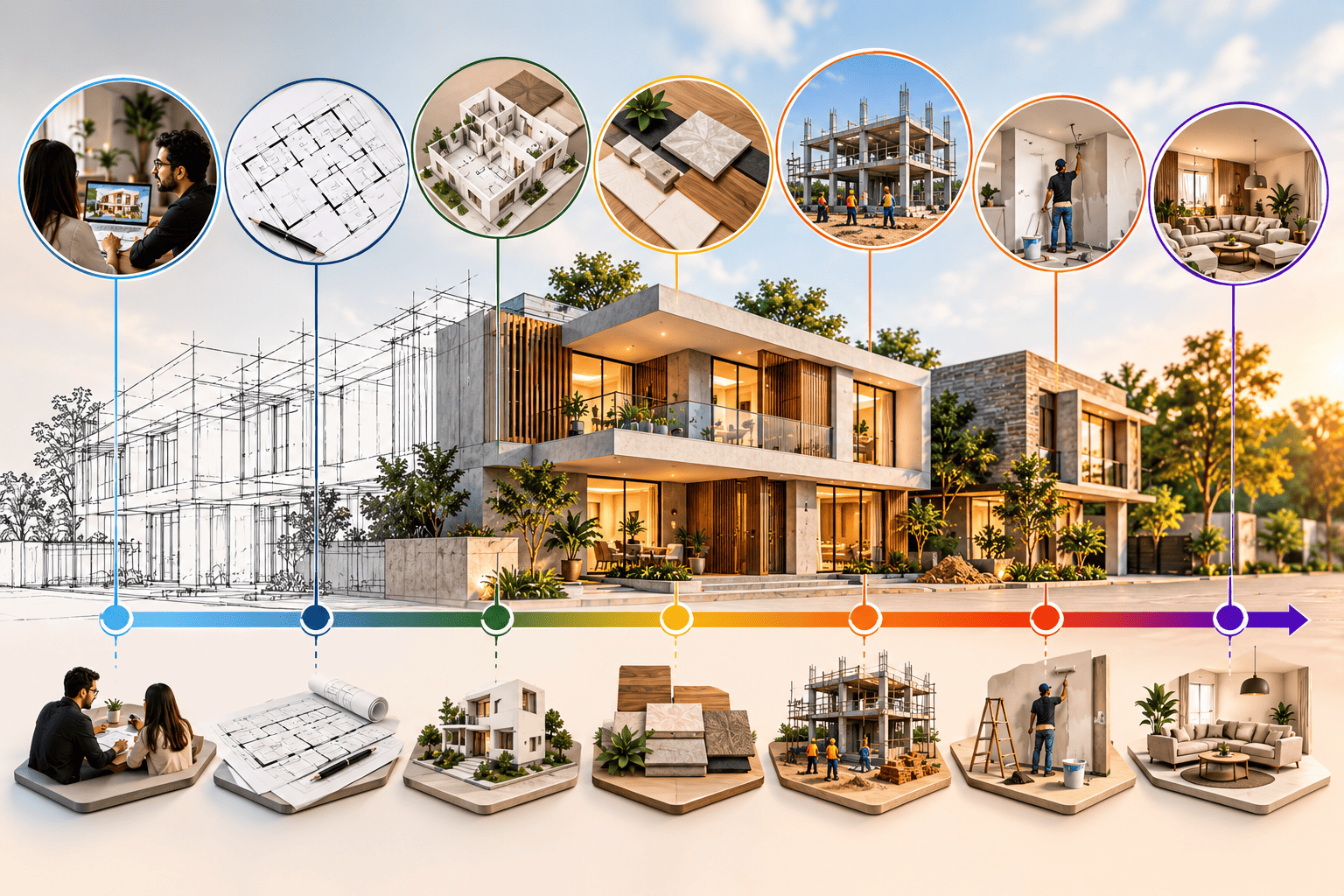
| Stage | What happens | Typical duration |
|---|---|---|
| Brief and site study | Measurement, site visit, requirements, constraints | 1 to 2 weeks |
| Concept design | Planning options, spatial direction, first review | 2 to 3 weeks |
| Design development | Chosen direction detailed, materials, services | 3 to 4 weeks |
| Working drawings | Everything a contractor builds from | 2 to 3 weeks |
| Approvals, where needed | Municipal submission and sanction | Highly variable |
| Execution | The build itself | 8 weeks to 18 months |
| Snagging and handover | Defects fixed, final clean, keys | 1 to 2 weeks |
These stages overlap in practice. Working drawings for one area often begin while another is still in development.
Why do approval timelines vary so much?
Because they depend on the local authority, the completeness of the submission and the type of project, none of which an architect fully controls.
What a practice can control is submitting a complete set the first time. Incomplete submissions are the most common cause of avoidable approval delay, and the second round always takes longer than the first.
Treat any promised approval date as an estimate, from anyone.
What actually causes delays?
In rough order of how often it happens:
- Decisions waiting on the client. A tile choice sitting unanswered for three weeks stops the wall, which stops the fixtures, which stops the handover
- Scope added mid-build. A wall moved after work has started costs more time than the same change made on paper
- Material lead times. Imported fittings and custom joinery can run eight to twelve weeks. This is manageable if planned, expensive if discovered late
- Payment delays to vendors. Labour moves to whichever site is paying. This is unglamorous and very common
- Trades out of sequence. Usually a coordination failure, which is the strongest argument for someone from the design side being on site
- Approvals. Real, but less often the culprit than people assume
How do I actually keep a project on schedule?
- Finalise the design before execution starts. The most expensive week on any project is the one spent changing something already built
- Make material selections early. Choose before work begins, not when the carpenter asks
- Name one decision-maker. Projects with two people who both need to approve everything run markedly slower
- Pay vendors on schedule. The fastest way to lose your labour is to be the site that pays late
- Book a weekly review slot. A fixed thirty minutes beats ad hoc calls, because questions queue up for it instead of waiting for someone to be free
Is a faster timeline worth paying for?
Sometimes. Compression is possible through parallel trades, overtime and premium lead times on materials, and it costs real money.
It is worth it for a commercial space where every week closed costs revenue, or a hard deadline you cannot move. It is rarely worth it on a private residence where the deadline is self-imposed, because compressed schedules reduce the time available for checking work, and that shows up later as defects.
Frequently asked questions
How long does interior design take for a flat in India?
Typically four to six weeks of design and eight to sixteen weeks of execution, depending on the extent of joinery and whether services are being altered.
How long does it take to build a house in India?
Twelve to eighteen months is a common range for a private residence from groundbreaking to handover, excluding design and approvals. Site conditions, scale and the approvals process all move it.
Can design and construction run at the same time?
Partly. Working drawings for later stages can be produced while early construction proceeds. Starting construction before the design direction is settled is how budgets break.
What is the longest part of a home project?
Execution, almost always. Design is a few weeks. Building is months.
Why has my project been delayed?
Most often a pending decision, a mid-build scope change, or a material lead time nobody planned for. Ask for a written status against the original schedule and the cause usually becomes obvious.
Rizwan Ahmad has delivered residential, commercial and turnkey projects for two decades across Delhi NCR and eastern India. See selected projects or start a conversation.