
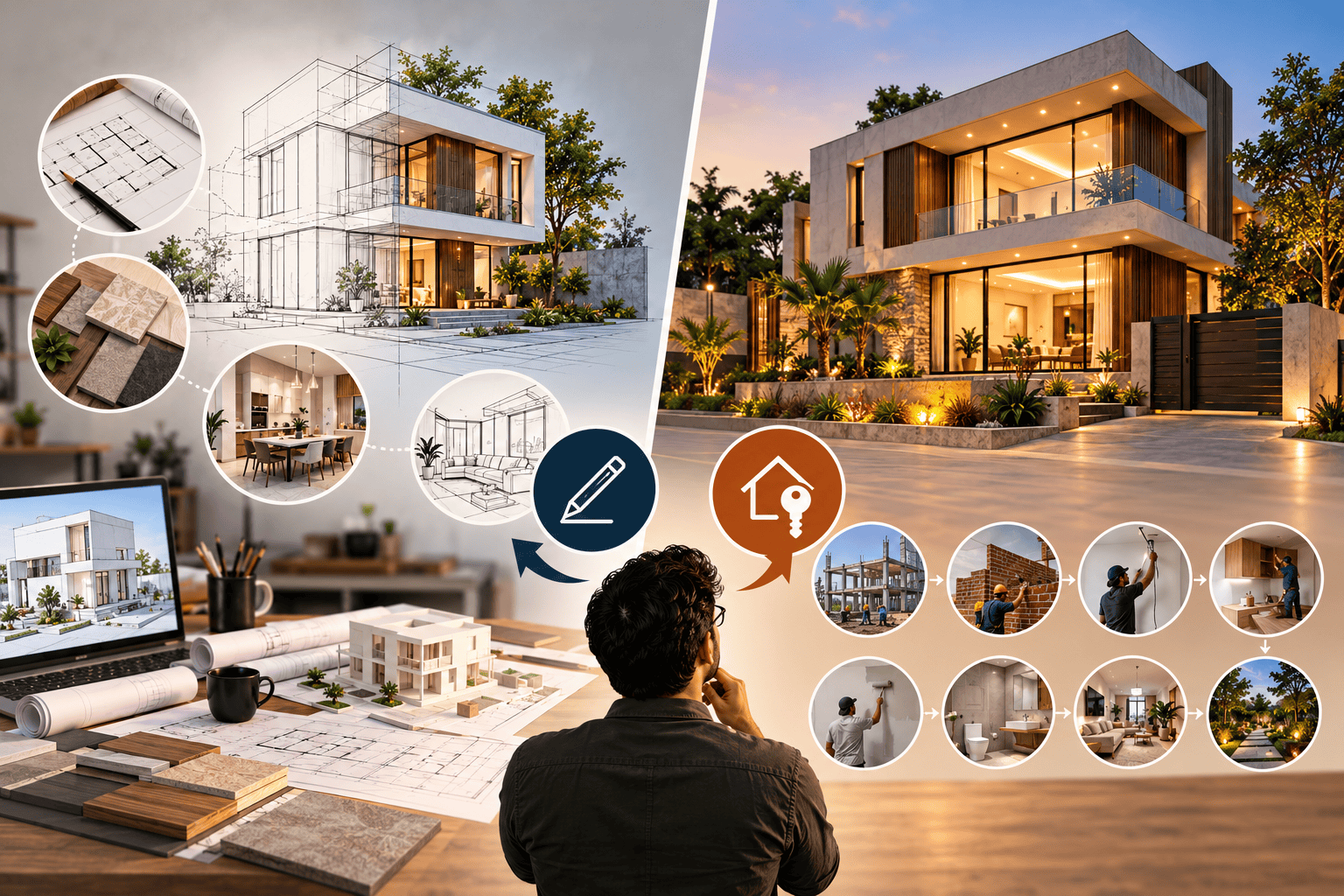
Design-only means you receive drawings and specifications, then appoint and manage contractors yourself. Turnkey means one party carries design, procurement and execution under a single contract and hands over a finished space. Design-only usually costs less on paper and more in your time. Turnkey costs more on paper and far less of your attention. The right choice depends less on budget than on how many hours a week you can genuinely spend on site, and how comfortable you are coordinating five trades who all blame each other.
What does design-only actually include?
A drawing set complete enough to build from: layouts, elevations, sections, electrical and plumbing drawings, joinery details, material specifications and a bill of quantities. Some practices include periodic site visits, some charge separately.
What it does not include is anyone answerable for what happens on site. That responsibility is yours.
What does turnkey include?
Design, material procurement, vendor management, execution and handover under one contract, one timeline and one point of contact. You approve the design and the budget, then approve the finished space.
The word to check is handover. Some turnkey contracts stop at civil and electrical work and exclude loose furniture, curtains and styling. Get the exclusions in writing before signing anything.
How do the two compare?
| Design-only | Turnkey | |
|---|---|---|
| What you receive | Drawings and specifications | A finished space |
| Who manages the site | You | The practice |
| Who holds the budget | You, paying each vendor | One contract |
| Your time commitment | High, often daily during execution | Low, at review points |
| Cost on paper | Lower | Higher |
| Where delays land | On you to resolve | On the contract |
| Change of mind mid-build | Easier, you control the vendors | Harder, it is a contract variation |
| Suits | Clients with time, local vendor contacts and patience | Clients short on time, or building away from where they live |
Is turnkey more expensive?
On the quote, yes, because coordination and risk are priced in rather than absorbed by you.
Whether it is more expensive in total is a different question. Design-only projects regularly run over on rework, material wastage, and the cost of a trade sitting idle because the one before it ran late. Those costs are real and they are invisible on the original comparison.
The honest answer: if you have the time, the local vendor relationships and the willingness to be on site, design-only usually lands cheaper. If you do not have all three, the saving tends to evaporate.
When does design-only clearly make sense?
- You live in the city where the project is and can visit regularly
- You already have trusted contractors and vendors
- The scope is small or simple enough to coordinate
- You want to phase the work over time rather than complete it in one run
- You genuinely enjoy this. Some people do, and it shows in the result
When does turnkey clearly make sense?
- The project is in a different city from where you live
- You cannot give it several hours a week
- There is a hard deadline, such as a move-in or a wedding
- It is a commercial space where every week of delay costs revenue
- You have done the design-only route before and did not enjoy it
What should I check in a turnkey contract?
A good turnkey agreement makes the following unambiguous: the exact scope with exclusions listed, the material specification with brands and grades named, a payment schedule tied to completed stages rather than dates, the handover date and what happens if it slips, the defect liability period, and how variations are priced if you change your mind.
The weakest part of most turnkey contracts is the material specification. If it says premium laminate rather than naming a brand and grade, you have agreed to a word, not a product.
Frequently asked questions
What does turnkey mean in interior design?
One party handles design, procurement and execution under a single contract and delivers a finished space, rather than handing you drawings to execute yourself.
Is turnkey interior design worth the extra cost?
It is worth it when your time is the scarce resource, when the project is in another city, or when the deadline is fixed. For a small project where you are on site anyway, the premium is harder to justify.
Can I start design-only and switch to turnkey later?
Sometimes, but it is cleaner to decide up front. A design produced without execution in mind may specify things the executing team would have detailed differently.
Who is liable if something goes wrong in a turnkey project?
The turnkey contractor, within the defect liability period defined in the contract. That period and what it covers should be written down before work starts.
Does turnkey mean I lose control of the design?
No. You approve the design before execution begins. What changes is that you are not coordinating vendors day to day.
Rizwan Ahmad offers both routes, from drawings-only engagements to full turnkey delivery. See what each covers or start a conversation.
