You need less than you think. Bring the plot or floor plan if you have one, a rough budget range you are comfortable saying out loud, a list of who will live or work in the space, and any images you have saved. Nothing has to be final. The purpose of a first meeting is for both sides to work out whether the project and the practice fit each other, not to begin designing.
What follows is the version that makes that meeting more useful.
What should I bring?
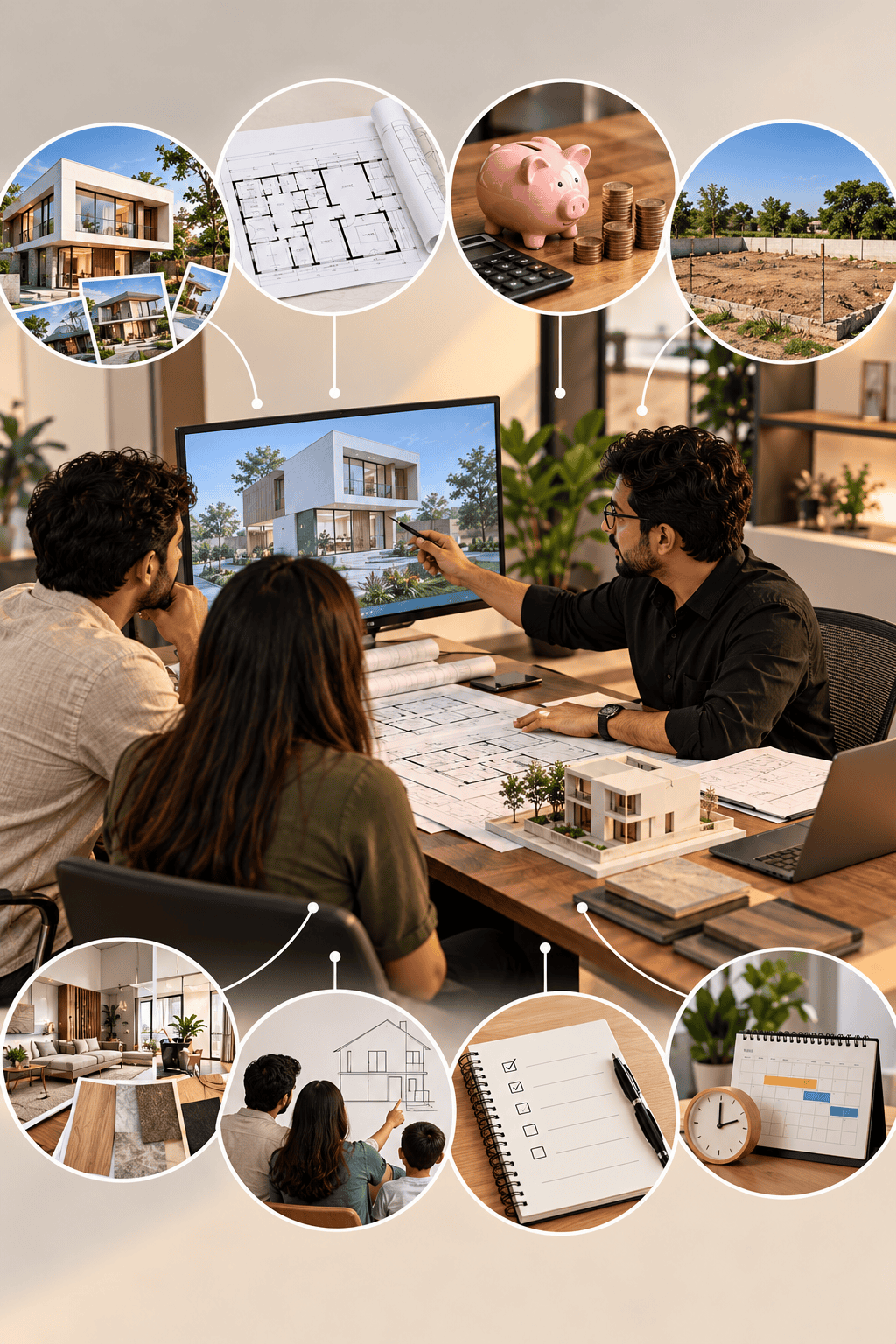
The plot or floor plan. A survey drawing, a builder’s plan, a society-issued layout, even a dimensioned sketch. If you have nothing, say so. It is measurable.
A budget range. The number people are most reluctant to share is the one that makes the conversation useful. Without it, any proposal is a guess, and you will spend the next month looking at options you were never going to build.
Who the space is for. How many people, their ages, who works from home, who cooks, whether parents visit for months at a time, whether there are pets. This shapes planning more than any image you can show.
What is wrong with where you live now. Often more informative than what you want. People struggle to describe an ideal home and can describe an annoying one in detail.
Saved images. Pinterest boards, Instagram saves, photographs of a hotel room you liked. Not because they will be copied, but because they reveal preferences faster than adjectives do.
Your timeline, and what is driving it. A wedding, a lease ending, a school year, a parent moving in. The constraint matters more than the date.
What should I ask?
The questions that reveal the most are rarely the obvious ones.
- Who will actually be on this project? The person in the meeting is not always the person doing the work. Ask directly.
- How many projects are you running right now? A practice stretched thin will not say so unprompted.
- Can I see a project you completed, not a render? Renders show intent. Photographs of finished work show execution.
- What happens when the contractor hits something unexpected? Every project has that moment. The answer tells you whether someone from the design side will be there.
- What is not included in your fee? More useful than asking what is included.
- Can I speak to a past client? A practice with completed work will say yes without hesitating.
What should I expect to come out of it?
Not a design. A first meeting should end with a shared understanding of scope, a rough sense of whether the budget and the brief are in the same universe, and a clear idea of what the next step costs.
If you leave with a design concept after an hour, be careful. Anyone can produce a concept in an hour. It will be a concept for a generic project, not yours.
How long should it take?
An hour to ninety minutes for a residential project. Less and the brief has not been covered. Much more and the conversation has drifted into designing, which is work, and should be paid for.
What if I do not know what I want?
This is normal and it is not a problem. Most people know what they do not want, which is a workable starting point. The brief is something an architect helps you build during the early stages, not a document you are expected to arrive holding.
What genuinely does stall a project is a budget nobody will state and a decision-maker who is not in the room.
Frequently asked questions
Is the first meeting with an architect free?
Usually yes for an initial conversation. A detailed site visit, measurement or a written proposal is work and is often chargeable. Ask when you book.
Do I need to have a plot before meeting an architect?
No. Many practices advise on plot selection, since orientation, access and local building rules affect what can be built there.
Should I share my budget with an architect?
Yes. Without a range, every proposal is a guess, and you lose weeks reviewing options that were never affordable.
How do I know if an architect is qualified?
Under the Architects Act, 1972, only a person registered with the Council of Architecture may practise under the title architect in India. Registration is a reasonable thing to ask about.
What if I meet several architects?
Sensible for a significant project. Give each the same brief and the same budget range, otherwise the proposals cannot be compared.
Rizwan Ahmad takes on residential, commercial and turnkey projects across Delhi NCR and eastern India. Start a conversation or see selected projects.