Most people asking this question have had two quotes that are nowhere near each other, and no way to tell which one is reasonable.
Architect fees in India are usually charged one of three ways: as a percentage of construction cost, per square foot of built-up area, or as a lump sum. In practice, percentage fees for residential work fall somewhere between 2% and 10% of construction cost, and per square foot rates run from about Rs 50 to Rs 250. Goods and Services Tax at 18% applies on top. The spread is wide because the number means almost nothing without the scope attached to it.
Why do two architects quote such different numbers?
Because they are quoting different work. A set of drawings you hand to a contractor is a different product from a practice that does site studies, municipal approvals, structural coordination, working drawings and supervision through to handover. Both are legitimately called architect fees.
Before comparing any two quotes, ask each one the same question: what exactly is included, and what happens on site after the drawings are issued?
What does the Council of Architecture say about fees?
This is where published sources disagree, and it is worth knowing that before you use any figure in a negotiation.
The Council of Architecture publishes a Scale of Charges as part of its Conditions of Engagement, under the Architects (Professional Conduct) Regulations, 1989. Some sources describe it as a mandatory minimum, citing 7.5% for individual houses and interior architecture and 5% for non-housing projects, plus 10% of the professional fee as documentation and communication charges. Other sources describe the same document as professional guidance rather than a binding tariff, and cite figures closer to 2% to 5% for residential work.
What is not disputed: the scale exists, it is tied to the cost of works excluding land, and actual market fees are negotiated.
There is one thing worth checking that has nothing to do with price. Under the Architects Act, 1972, only a person registered with the Council of Architecture may legally practise under the title architect in India. Registration is a reasonable thing to ask about on a first call.
What do the three fee models actually mean?
| Model | How it works | Suits |
|---|---|---|
| Percentage of construction cost | A set percentage of what the build costs, excluding land | Projects where the final scope is still moving |
| Per square foot | A rate on built-up area, fixed at appointment | Projects with a settled area and a clear brief |
| Lump sum | One agreed figure for a defined scope | Small, tightly defined work |
The percentage model has a quirk worth understanding. If the fee is a percentage of construction cost, the architect earns more when the building costs more. Good practices handle this by agreeing the percentage against an estimated cost at appointment, so later cost increases do not quietly inflate the fee. Ask how that is handled before signing.
When is the money actually paid?
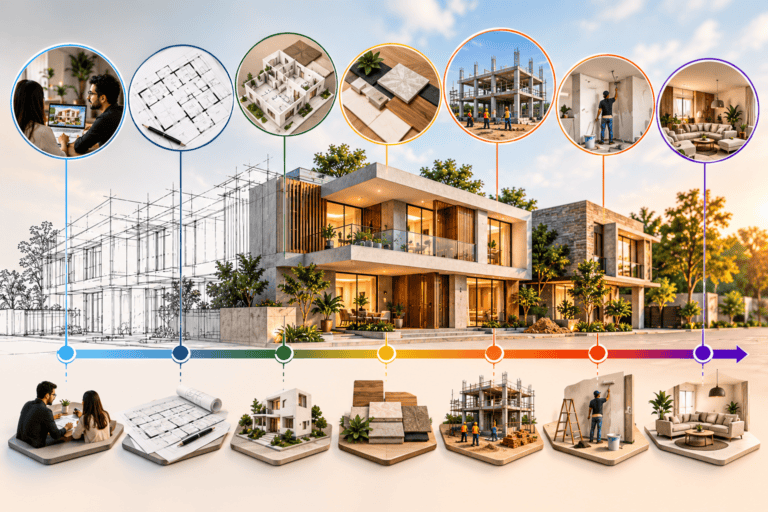
Architect fees in India are almost always staged against project phases rather than paid up front. A common structure looks roughly like this:
- Concept and schematic design, on appointment
- Design development, once the direction is agreed
- Working drawings, before construction begins
- Site supervision, usually monthly through the build
The exact split varies. What matters is that each payment is tied to something delivered, and that the structure is written down.
What drives the cost up or down?
- Scope. Drawings alone sit at the bottom of the range. Full service with supervision sits at the top
- Location. Metro projects typically carry higher fees than tier-two cities, partly because site visits cost time
- Complexity. A sloped plot, a heritage constraint or a structure that fights its own plan all add drawing work
- Area. Smaller projects carry higher percentages, because the effort does not scale down proportionally
- Repetition. The second identical unit costs less to design than the first
What should the agreement say?
At minimum: the scope in writing, the fee and how it is calculated, the payment stages, what counts as a reimbursable expense such as travel or printing, how many design revisions are included, and what happens if the project is paused or the scope changes.
A fee with no written scope behind it is not a quote. It is a number.
Frequently asked questions
How much do architects charge in India?
Fees typically run between 2% and 10% of construction cost for residential work, or roughly Rs 50 to Rs 250 per square foot of built-up area, with 18% GST on top. The range reflects differences in scope more than differences in quality.
Is the Council of Architecture fee scale compulsory?
Sources disagree. Some treat the Scale of Charges as a mandatory minimum under the Architects (Professional Conduct) Regulations, 1989, others as professional guidance. In practice fees are negotiated between client and architect.
Does GST apply to architect fees?
Yes. GST at 18% applies to architectural professional fees in India.
Can I hire an architect only for drawings?
Yes. Drawings-only engagements are common and sit at the lower end of the fee range. The trade-off is that nobody from the design side is on site when decisions get made during construction.
Is land cost included when calculating the fee?
No. Percentage fees are calculated on the cost of works, which excludes the cost of land.
Rizwan Ahmad has worked on residential, commercial and turnkey projects for two decades across Delhi NCR and eastern India. See the services we offer or selected projects.